

From Leads to Revenue: Mapping Your Funnel for Digital Marketing
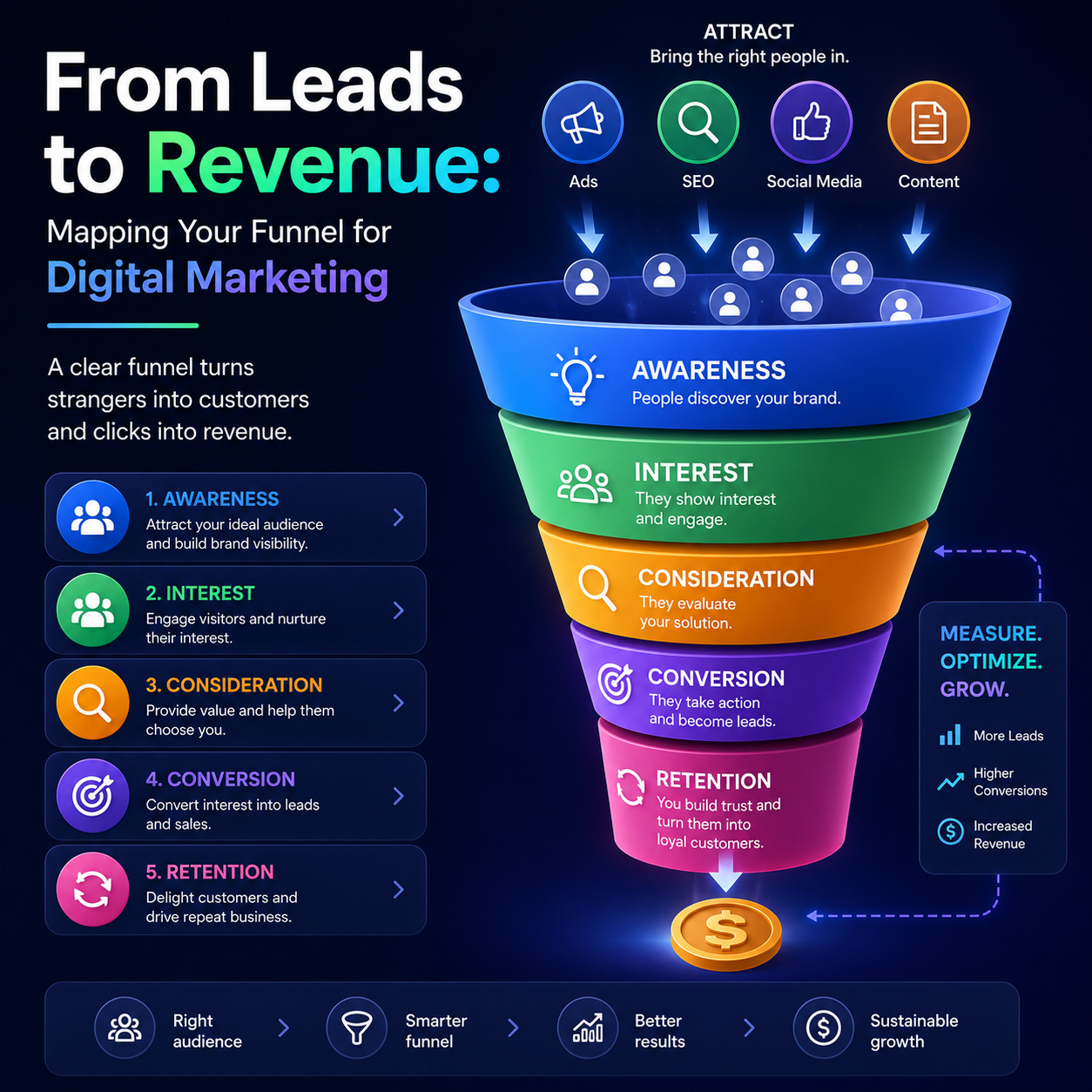
A funnel is a set of bets you can measure
Digital marketing often fails at a simple step: it generates traffic, but it doesn’t connect it to revenue. A funnel fixes that by defining each stage—attention, consideration, conversion, and retention—and then instrumenting those stages with tracking and experiments.
For small businesses, the goal isn’t a complicated multi-million-dollar funnel. The goal is to make your funnel predictable enough that you know what to improve next.
Step 1: Define your conversion event (the “money moment”)
Before mapping the funnel, decide what counts as success. Examples:
- Form submission
- Booking a call
- WhatsApp message
- Call from a “Click to Call” button
Then build everything to support that single event. If you track nothing, you can’t optimize.
Step 2: Create offers that match the stage
Different stages need different types of offers.
- Top-of-funnel: free guide, checklist, webinar, awareness content
- Mid-funnel: audit, case study, template, comparison page
- Bottom-of-funnel: quote request, demo, consultation, limited-time package
If your ad promises one thing but your landing page asks for something else, conversion drops. Align promise-to-page-to-form.
Step 3: Map traffic sources to landing pages
Not all visitors are equal. Map traffic sources to different landing pages:
- SEO visitors: informational to solution bridge (guide → service page)
- Paid social visitors: short benefit summary + proof + CTA
- Search visitors: landing pages that match the query intent
Even within the same service, create variations: one for “pricing,” one for “process,” one for “best for small business,” etc.
Step 4: Build a measurement plan you can actually use
Most teams measure too late or too vaguely. Use a simple funnel dashboard.
Track these per campaign and per landing page:
- Clicks
- Engagement: time on page, scroll depth, bounce (directionally)
- Lead events: form start, form submit, call clicks
- Conversion rate: submit / visits
- Cost metrics (for paid): CPC, CPA, cost per lead
Then decide: what’s the biggest bottleneck right now? Usually it’s either click quality or landing page clarity.
Step 5: Run experiments with a “hypothesis” mindset
Instead of changing random elements, run experiments:
- Hypothesis: “If we add pricing clarity above the fold, conversion rate will improve.”
- Change: add a pricing range or package table.
- Measure: compare conversion rate over 1–2 weeks.
- Decide: keep, iterate, or rollback.
Small businesses win by improving one lever at a time.
Step 6: Strengthen the post-lead stage (speed + relevance)
Leads don’t convert themselves. The response speed and follow-up content matter.
- Respond quickly (ideally within hours, not days)
- Confirm needs using 2–3 discovery questions
- Send relevant next steps (proposal outline, sample work, timeline)
- Use consistent language with your landing pages
Step 7: Retarget to fill gaps in the journey
Some people need multiple touches. Retargeting is a way to reintroduce proof and clarify your offer.
Good retargeting sequences:
- Visitor → proof ad (case study testimonial)
- Form starter → reassurance ad (process + FAQ)
- Lead → conversion ad (call scheduling or package details)
Revenue comes from aligned stages: traffic that matches intent, landing pages that reduce doubt, and follow-up that keeps momentum.
A simple funnel template (copy/paste)
- Stage: Awareness / Consideration / Conversion
- Goal: What metric defines success?
- Offer: What will the visitor receive?
- Landing page: Where will they go?
- CTA: What action do they take?
- Tracking: What events do we log?
- Experiment: What do we test next?